The Monitor Mindanao Post: Group warns researchers of predatory publications
2026-06-15
Group warns researchers of predatory publications
By: Uriel Quilinguing
CAGAYAN DE ORO CITY – The Federation of Authors in Criminology and Criminal Justice, Inc. (FACCI) has cautioned postgraduate students against engaging the services of persons who offer outright publication for a fee of thesis or dissertation findings and other academic research results.
Publication of academic work has been a prerequisite for the conferment of master and doctoral degrees by the Commission on Higher Education (CHED) so that evidence-based conclusions could enrich the compendium of knowledge, bridging the gap between the theoretical and the real world.
But FACCI, a Quezon City-based professional academic organization of over a hundred authors nationwide, has yet see this altruistic objective is realized because research outcomes often end up published by what the group described as predatory journals, thus these are inaccessible to other researchers.
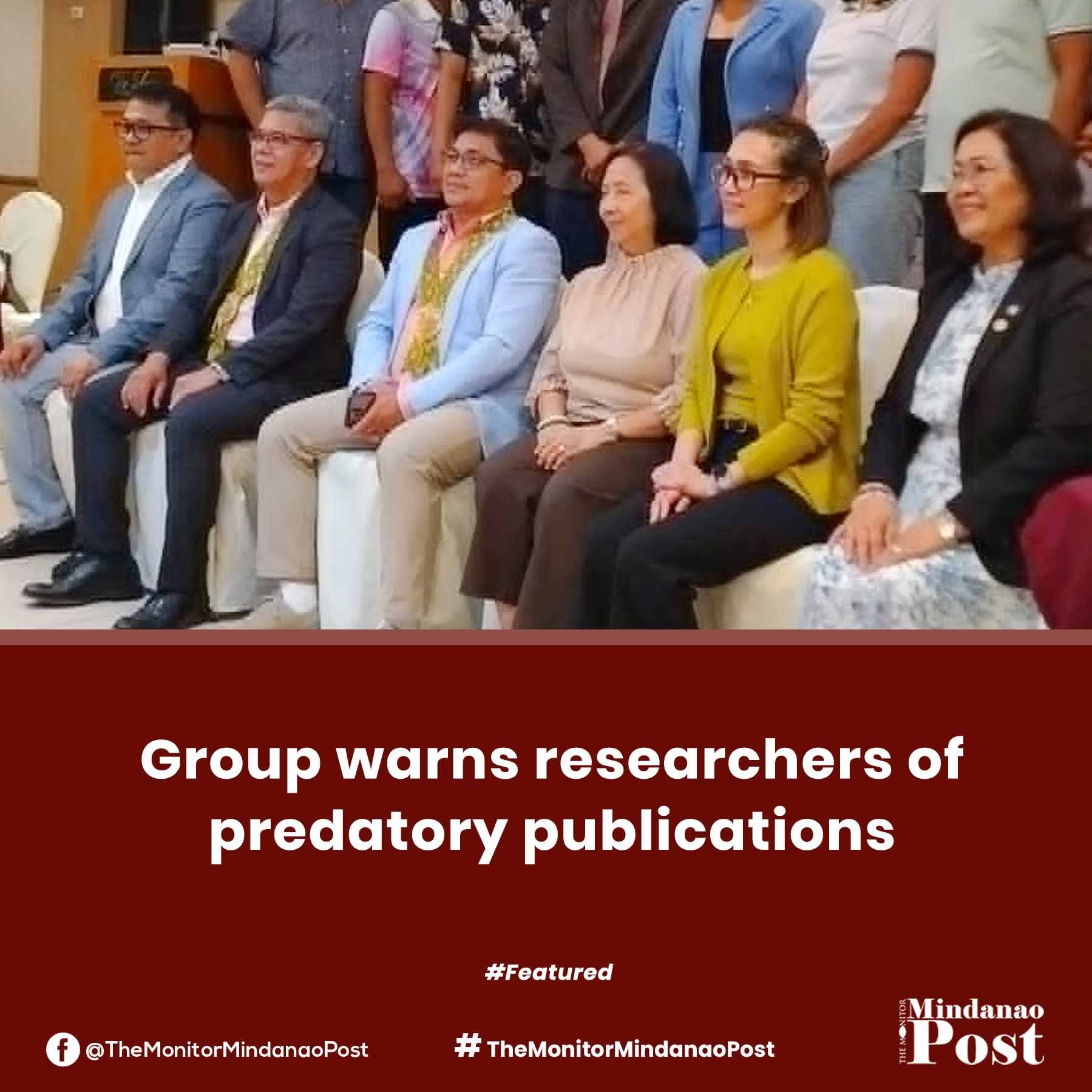
To address this concern, FACCI organized a three-day training on Designing Criminological and Criminal Justice Research at the De Luxe Hotel in Cagayan de Oro City that ended Sunday, May 17, participated in several dozens of state and privately-owned colleges and universities with criminology academic programs, across the country.
In an open forum, FACCI President Ramil G. Gabao, who chairs the Technical Panel for Criminal Justice Education in the Commission on Higher Education (CHED, said the aphorism “publish or perish” in the academe for job promotion, tenure, and ensure success in one’s academic career exists. This, he said, does not mean one would just settle for publication-for-a-fee offers from shady publishers.
FACCI has secured its International Standard Serial Number, listed in the portal as ISSN 2619-8223, and has been publishing the FACCI Research Journal twice in a year, peer-reviewed as a legitimate publication in the Philippines. The ISSN is a minimum technical standard before a journal is evaluated for inclusion in the academic research index.
Once a journal appears in the official Scopus Source List, its published materials could be accessed and cited in the international academic researches, according to College of Education Dean Aisa Parreńo-Arios of Far Eastern University Manila. She is the editor-in-chief of the FACCI Research Journal.
Parreńo-Arios said publication is free of charge in journals that have been indexed and source-listed in Scopus, but publication schedule would be subject to the time of submission, peer-review and acceptance, and the possibility of rigorous revisions in the alignment of its format and abide with editorial and scholarly standards. Publication is either in print or digital form, and may be both.
As of this writing, there are only about a dozen journals in the Philippines that appear in the Scopus Source List. The highly recognized Scopus database is owned by Elsevier publishing company that stores massive multidisciplinary abstracts of indexed research studies worldwide.
Journal indexing is the inclusion of an academic journal’s articles in bibliographic databases and search engines by Clarivate that tracks the most impactful research.
‘DECOLONIZE’
The FACCI Research Journal is exclusively published by Wiseman’s Book Trading, Inc., (WBTI) which is also based in Quezon City, the company that responded to persistent clamor for books written by Filipino authors.
Dean Gerry J. Cańo of PHINMA-Cagayan de Oro College, who chairs the Council of Deans in Criminology Education in Northern Mindanao, said that for over seven decades, books by foreign authors served as instructional materials when there are professional criminologists who could be at par--and perhaps even better—with those from abroad. Criminology profession was introduced in the Philippines in 1954.
Cańo, the incumbent national president of the Professional Criminologist Association of the Philippines (PCAP), said they have been pushing for the “decolonization” of criminology education in the country by optimizing books written by Filipino authors. He is also the president of the Asian Criminological Society (ACS) whose membership includes renown criminology experts from Australia, China, Japan, and the United States of America.
He said the seminar-workshop on designing researches on criminology and criminal justice so that these would adhere to standards and quality set by local and international publications is on the right direction.
Elizabeth R. Ocampo, president of a family-owned book publishing business, said that aside from the FACCI Research Journal, their company is the official distributor of over 800 titles of books from about 300 authors. These include textbook, workbook, and instructional materials on criminology and justice education.
Ocampo said some of the books they published and market had reached multiple editions, most notable of these is the book on traffic management by a Filipino author which is currently on its 5th edition.
LIGHTHOUSE
Although CHED Commissioner Desiderio R. Apag failed to grace the event’s opening due to equally important gathering in the Visayas, his prepared keynote speech was incidentally apt as a challenge to the participants who were trying to figure out the relevance of professional criminologists who remain jobless despite passing the licensure examination.
Apag’s talk took off from an analogy of a lighthouse, that the structure would be of no use at nighttime if it is not lighted. He went further by saying its relevance is appreciated and recognized only if it serves its purpose of guiding seafarers to safety. Professional criminologists are like lighthouses, he said.
With over 350,000 criminologists, the criminology profession is the third country’s largest behind teachers (2.2 million) and nurses (1.1 million) and thousands could be absorbed into the ranks into the labor force. In 2025, more than 50,000 became professional criminologists and yet the regular and attrition quota of the Philippine National Police last year was only about 10,000.
Gabao, whose other demanding role of being the chairperson of the Professional Regulatory Board of Criminology under the Professional Regulation Commission (PRC), said that the 66-percent passing percentage in the March 2026 Criminologists Licensure Examination (CLE) created an “unintended problem.” It was the highest CLE passing percentage on record, way above the 33 percent posted in December 2022 CLE.
He urged the training participants, composed mostly of criminology deans, professors and instructors, to consciously adopt a paradigm shift among their students that becoming a criminologist does not only mean joining the ranks of the police force. – Uriel Quilinguing
---------------------------------------
Follow Us: https://www.facebook.com/themonitormindanaopost
#PCAP
#FACCI
#CDCE
#TheMonitorMindanaoPost
#MindanaoPost
The Monitor Mindanao Post
May 19 at 7:55 PM